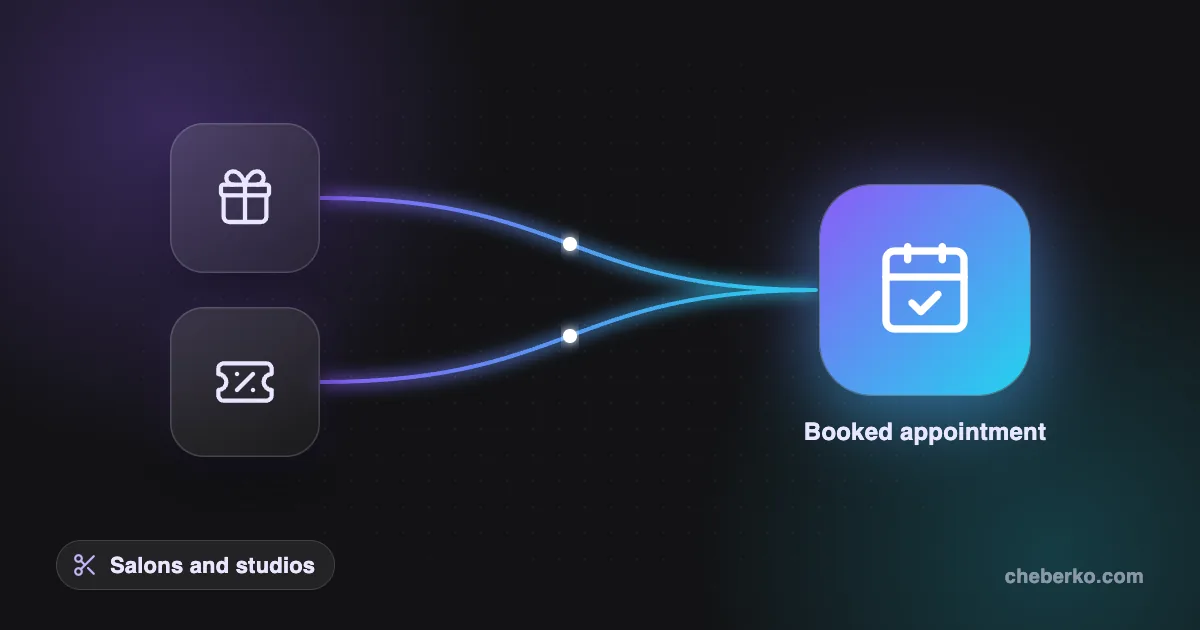
A client buys three gift cards at your salon on Black Friday. Unless each salon promotion has its own code, you can't tell which one sold them or whether anyone came back. The holiday promotions worth running each do one named job and carry their own code, so the count shows which one worked.
Quick answer
- Name one job per promotion: fill slow weekdays, win back lapsed clients, sell gift cards, land first visits or reward referrals.
- Give every promotion its own code or booking link before it goes out.
- Count redemptions, first visits, and second visits 60 days later.
- Keep reviews out of every promotion: Google removes reviews posted because of an incentive.
- Get texting consent in writing before the first holiday text.
Five promotions and the jobs they do
Pick the job first and the promotion follows. The table below pairs each promotion with its job.
| Promotion | Job it does | Count | Check before it goes out |
|---|---|---|---|
| Bonus on gift cards | Cash before December | Cards sold, bonus redeemed, lapsed clients who return | Gift card disclosures |
| Weekday offer | Fill slow Tuesday to Thursday slots | Bookings in those slots using the code | Say the end date in the ad |
| Win-back text or email | Bring back clients unseen for 6 months | Replies, bookings, second visits | Consent, opt-out |
| First-visit offer | Land new clients | New clients with the code, second visits | Show the terms before she books |
| Referral credit | Reward clients who send friends | Friends who came, friends who returned | Review and email rules |
Deal sites are a sixth route. Groupon for business walks through the commission math.
Every offer gets a code or a link
The code does the counting, and a simple sheet is enough. As a media buyer, I managed nearly $700K in Google Ads and Meta Ads spend; nothing went live without its own label.
Set it up today, count it later:
- Open your booking app's promo code or discount settings.
- Create one code per promotion, such as
GIFT25,WEEKDAYandFRIEND. - Ask the app where the code appears in a report. If it does not, ask the front desk to type it into the notes of every booking.
- Add a column to your sheet for first visit date and second visit date.
- Sixty days after the promotion ends, count how many code users booked again.
If your booking page is the free one that came with the app, the salon website design post compares it with your own site.
Gift cards: the rules that bite
Money on a plastic or electronic gift card you sell can't expire for five years. Money on a free bonus card can, if the card itself says so. The federal rule, Regulation E, covers a dollar-amount card you sell, plastic or electronic, but not a certificate issued only on paper. On a covered card, the funds cannot expire earlier than five years after it was issued or last loaded.
An inactivity fee is allowed only after a full year with no activity, at most once a calendar month, and only if the card states the fee.
So "buy $100, get a $20 bonus card that expires January 31" works only when the bonus card carries those lines. A sticker or a flyer does not count, because the rule wants the terms on the card itself. Your state may be stricter. This post is not legal advice, and I'm not a lawyer.
Ask your booking software for two things:
- Show me where a gift card records who bought it and who redeemed it.
- Print a sample bonus card or e-card so I can see where the terms sit.
In Ontario, the province's gift card page says most retail gift cards cannot carry an expiry date or a dormancy fee that eats the balance. A card for one specific service, such as a spa massage, can expire, and so can one issued for charity.
Referrals and reviews: two rules that pull apart
A referral credit is the easiest promotion to count, because the friend gives you a code. Pay the credit after the friend's first visit, not when she books.
Say you email the offer and ask clients to forward it. The FTC's CAN-SPAM guide says a seller who gives discounts for forwarding a message "may be responsible for compliance." Treat every forward as your own email.
The FTC rule applies only in the US. Google's policy goes further and removes reviews posted because of an incentive offered by the business. If your reviews sit on Google, "a free product for a review" fails there even where the FTC would let it pass.
Asking only your happiest clients is a separate problem; the FTC says it could violate the FTC Act. If a review vanished after you asked for it, that post lists the causes.
Email and texts to past clients
CAN-SPAM covers a promotional email to past clients just as it covers one to strangers. It requires an honest subject line, your postal address and a working opt-out. You have 10 business days to honor it, and a violation can cost up to $53,088 per email.
Texts can have tighter consent rules. The FCC's rule covers marketing calls and texts to cell phones sent with an autodialer or an artificial or prerecorded voice. Those need prior express written consent: an agreement the client signs for that number, and an e-signature counts.
The agreement must say she authorizes those messages and is not required to sign as a condition of buying. A reply of "stop," "cancel" or "unsubscribe" revokes consent, and the rule allows a reasonable time, at most 10 business days, to honor it. Ask your texting tool whether it keeps those signatures.
In Canada, CASL bans a commercial email or text sent without consent, express or implied. Consent is implied for two years after a purchase and six months after an inquiry. An unsubscribe must take effect within 10 business days.
Gift card or referral: the day-60 count
Divide what each promotion cost by the clients it brought back within 60 days.
Sources checked on 2026-10-25.
Tags
Frequently asked questions
Can a salon give a bonus card with every gift card it sells?
Yes, but the federal gift card rule treats a free bonus card differently from the card a client buys. The bonus card is outside the five-year expiry rule only if its front says it is promotional and shows when the funds expire; if it carries fees, it must also state them and give a toll-free number. The card the client paid for keeps the five-year floor. This is not legal advice; your state may set stricter rules.
Can I give a discount to clients who leave a review?
The FTC's review rule does not ban an incentive for a review unless it is tied to what the review says. Google's policy goes further and removes reviews posted because of an incentive from the business. Keep reviews out of every promotion: if yours sit on Google, an offer for a review gets the review removed.
Do I need permission to text clients about a holiday offer?
For marketing texts sent with an autodialer or an artificial or prerecorded voice, the FCC rule calls for the client's signed written consent, and the form must say signing is not required to buy anything. A client can stop the texts by replying STOP or a similar word, and you must honor it within a reasonable time, no more than 10 business days. In Canada, CASL covers texts and email and needs consent, express or implied, before the first message.
When can I tell whether a holiday promotion worked?
Judge it at 60 days after it ends, not on the last day. Redemptions show the same week, but whether a first-time client booked a second visit only shows later. Count both against the code or link you gave that promotion.
Is a referral program worth running for a small salon?
It is worth it when the cost per referred client who comes back is lower than what you pay for a new client elsewhere. Give the program its own code, pay the credit only after the friend's first visit, and divide the total credits and discounts by the friends who came back. If it is higher, shrink the credit.

Written by
Marketing Analytics & Conversion Tracking Engineer, US and Canada, run remotely
- Media buyer on Google Ads and Meta Ads from October 2023 to September 2025, nearly $700K in spend.
- Set up patient conversion tracking for a New York medical practice (anonymized).
- Upwork Top Rated Plus, 5.0 from 20 reviews.