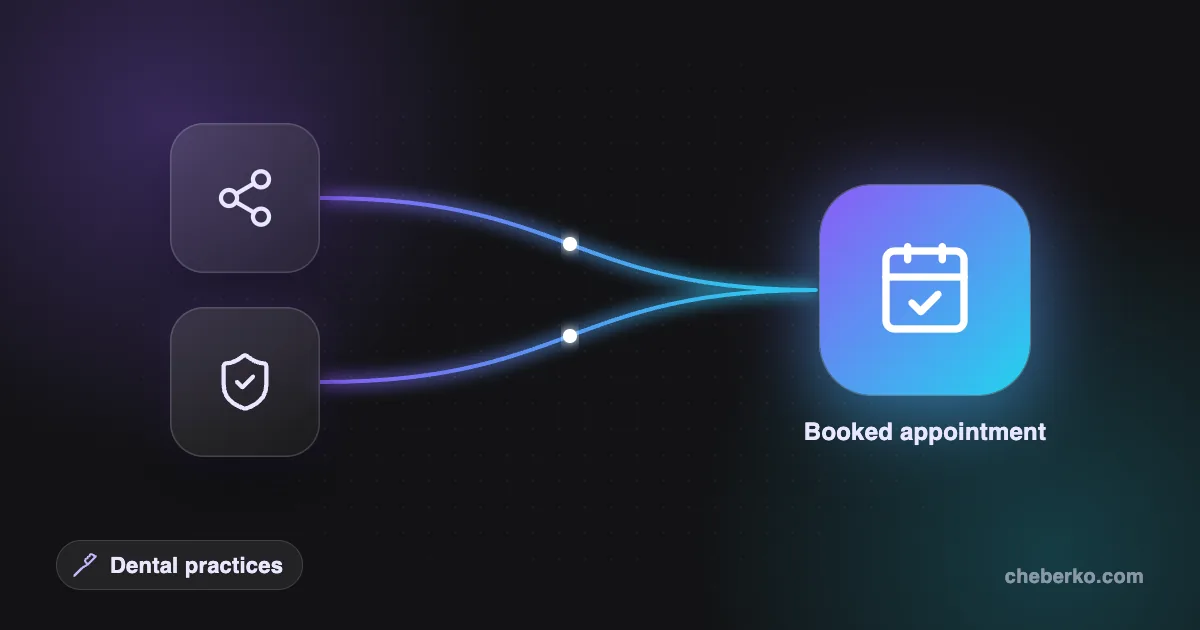
Dental social media marketing does two jobs. Free posts reassure people who already found you somewhere else, and paid promotion reaches nearby strangers. Count taps on Book and booked visits for the first job, new patients per dollar for the second, and ignore follower totals for both.
Quick answer
- Today, open your Instagram and Facebook on a phone that isn't logged in as the practice, tap Book and the link in bio, and see where each lands.
- Add tracking tags to the link in your bio so Google Analytics can name the visit.
- Get a signed authorization before any patient photo, name or story goes up.
- Ask whoever posts for you for taps, booked visits and new patients, not followers.
Two jobs, two counts
A post is hard to judge on new patients, because the person who sees it may have found you on Google first. Social media is where they check that the office looks real. The first three rows below are the free job; the last row is the paid one.
| What you do | What it is for | The one number | Where it lives |
|---|---|---|---|
| Profile and link in bio | Turn a visitor who looked you up into a booking request | Taps that end in a booking request | Google Analytics, session source "instagram" or "facebook" |
| Posts and reels | Show the office and team to people already weighing you | Profile visits that become taps on Book | The account's insights screen, then Analytics |
| Comments and DMs | Answer a question and move it to the phone or booking page | Conversations that become a booked visit | A tally at the front desk |
| Boosted posts and ads | Reach nearby people who don't know you | New patients per dollar | Practice software, with a "how did you hear about us" field |
Paid Meta ads have their own rules on what a dental ad may show and how leads are handled.
Walk your profile as a stranger
Use a phone that isn't logged in as the practice, so you see what a new patient sees.
- Search your practice name in Instagram and in Facebook.
- Tap the link in your bio. Write down where it lands: the booking page, the home page or a dead end.
- Tap Facebook's action button, if the Page has one. Note where that lands too.
- Copy the bio link and read the full address. If it has no
utm_tags, Analytics cannot tell this link from other visits. - Add tags:
?utm_source=instagram&utm_medium=social&utm_campaign=bio-link, and the same withutm_source=facebookon the Page's link. - Next day, open Reports, then Acquisition, then Traffic acquisition, and look for that source and medium.
Use lowercase every time and keep one list of the tags you made. For what happens after the tap, see appointment booking conversion tracking.
What a patient's photo or story needs
In the US, a patient's photo, name or treatment story on social media counts as marketing under HIPAA, so it needs the patient's signed authorization first. The rule is 45 CFR 164.508(a)(3). The exceptions are a face-to-face conversation and a gift of nominal value, and neither covers a post.
The authorization must name the information, who may use it and who may receive it, each purpose, an expiration date or event, and carry a signature and date. If a third party pays you for the post, it must say so. The patient can revoke it by written notice and gets a copy.
Cadia runs rehabilitation and nursing facilities, not dental offices, but the authorization rule is the same. OCR's statement names business associates too, so ask an agency that posts for you who collects the signed authorization.
State dental boards add their own rules. Texas, for example, lets a dentist use photographs of actual patients of record, requires written consent before identifying details are shared, and requires the ad to say "Actual results may vary." Your own state's board may say something different.
In Ontario, HIPAA doesn't apply: section 33 of the privacy law PHIPA bars using a patient's health information for marketing without express consent. The dental college's advertising advisory also lists testimonials and giveaways among things to leave out.
Contests, staff posts and bought followers
In the US, the FTC's review rule, 16 CFR Part 465, bars giving pay or perks in exchange for reviews that express a particular sentiment. A giveaway that rewards five-star reviews is exactly that. The rule also bars buying fake followers or likes when the buyer knew or should have known they were fake.
Officers and managers who review their own business must disclose the connection. Under the Endorsement Guides, so should a staff member who promotes the practice, and the practice should train staff to do it.
The Guides put the advertiser on the hook too: you can be held liable for an endorser's misleading claims, and a "results not typical" line generally doesn't fix a misleading one.
When a flat monthly fee pays back
Divide what the posts cost by what one new patient is worth. The answer is how many new patients the fee has to bring in each month.
Use your own numbers: taps from Analytics, finished bookings from your booking tool, new patients from your practice software. Run it for a few months before you decide.
Logins, signed forms and the report
- Ask who owns the Instagram and Facebook accounts and who holds the logins.
- Find out where signed patient authorizations are kept and who checks them before a post.
- Check that the report shows taps on Book, booked visits and new patients, not only followers and reach.
- Confirm the bio link is tagged and see who gets the Analytics report.
- Ask what happens to the accounts when the contract ends.
If the agency also runs your Google profile, see Google Business Profile for doctors for what a profile owner should control.
Sources checked on 2026-10-31.
Tags
Frequently asked questions
How do I know if Instagram brings my dental practice new patients?
Tag the link in your bio so Google Analytics can name the visit, then ask every new patient how they found you when they book. Match the two counts to the new-patient list in your practice software. If taps are high and new patients from that source are near zero, the posts are doing the reassurance job only.
Can a dental practice post a patient's smile photo or review on Instagram?
In the US, generally only with the patient's signed HIPAA authorization, because an identifiable photo or story is protected health information used for marketing. HHS's Office for Civil Rights has said a valid, written authorization is generally needed before posting a patient's information in a testimonial or social media campaign. State dental boards add their own rules on top. In Ontario, the privacy law PHIPA requires the patient's express consent for marketing, and the dental college lists testimonials among things to leave out of ads.
Is a boosted post the same as a Facebook ad?
Meta's help center calls a [boosted post](https://www.facebook.com/business/help/317083072148603) an ad made from a post you already published, and it shows on your bill as an ad. It has fewer targeting and customization options than an ad built in Ads Manager. Both belong to the paid job, so judge them by new patients per dollar from your practice software, not by likes.
Can I run a giveaway on my practice's Instagram?
It depends on your regulator. Ontario's dental college lists incentive programs such as giveaways and contests among things to leave out of advertising. In the US, the FTC rule bars rewarding reviews for a particular sentiment, and state boards differ, so read your board's advertising rule first.
Should my front-desk staff post about the practice from their own accounts?
They can, but the FTC's Endorsement Guides say an employee who promotes the employer's business should clearly disclose that job, and the employer should train staff to do it. Give staff a short rule: no patient names, faces or stories, and say they work there.

Written by
Marketing Analytics & Conversion Tracking Engineer, US and Canada, run remotely
- Media buyer on Google Ads and Meta Ads from October 2023 to September 2025, nearly $700K in spend.
- Set up patient conversion tracking for a New York medical practice (anonymized).
- Upwork Top Rated Plus, 5.0 from 20 reviews.