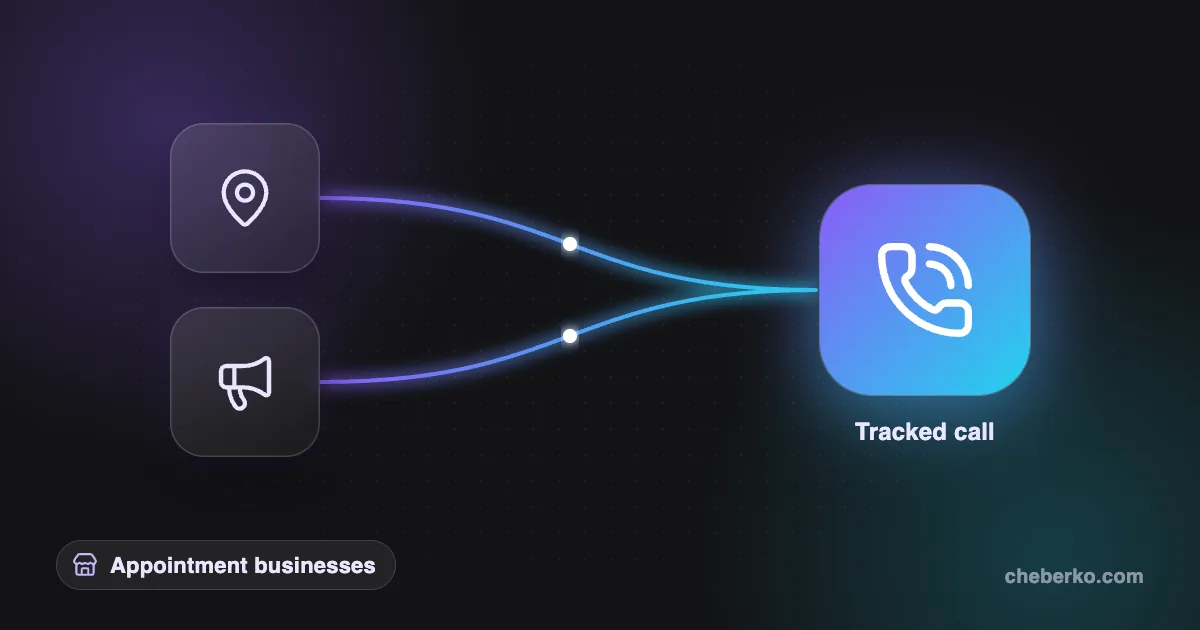
Call tracking gives each ad, listing or web page its own phone number that forwards to your real line. Every call arrives labeled with where the caller came from. It tells you which source rings the phone, not who booked or paid, until you connect the log to your schedule.
Quick answer
- Ask your agency which numbers exist: one per channel, plus a pool on the website.
- Add the tracking number to your Business Profile as an extra, then check what the listing shows.
- Find out whose name the account and the numbers are in.
- Judge each source by booked calls and cost per booked call, not by total calls.
- Turn on a recording notice before the first call is recorded.
Two ways a number gets handed out
Every tracking number is a spare line that rings your real phone. What differs is who sees which number.
A channel number is the simple kind. You print it on one postcard run and every call to it belongs to that run.
A website pool is the other kind. A script on your site swaps the number each visitor sees, called dynamic number insertion. CallRail's help says each pool number goes to one visitor at a time, so a call can be linked to the visit, its source and, for paid ads, the keyword.
Google does this for ads at no charge with its own forwarding numbers.
What the call log answers, and what it leaves blank
The log of a call tracker, such as the one in CallRail that I've worked in, lists the caller's number, the tracking number dialed and how long the call ran. That makes it a source report, with nothing about the patient or client.
| You ask | The log answers | It leaves blank |
|---|---|---|
| Which source rings the phone most? | Calls by tracking number, with time and length | Whether a first-time caller is really a new patient or client |
| Which keyword brought a call? | The ad keyword, if the caller saw a website pool number | Organic search terms, which aren't passed, and a caller who dialed your main line from memory |
| Did the call book? | The length, plus a tag if staff add one | The booking itself, which sits in your scheduler |
| Who paid? | Nothing | Revenue, which sits in your billing system |
Matching calls to appointments is its own step.
Which numbers you own, and what happens when you leave
Google's Business Profile guidelines say a listed phone number must be under the direct control of the business. The page never mentions tracking numbers, so the question it leaves is whose account holds yours.
The page that adds numbers lets you list up to two more beside the primary one. It doesn't say which of them customers see. Test it: add the tracking number as an extra, then search your business on your phone and read what shows.
Switching a number off is faster and harder to undo. A deactivated CallRail number can be reactivated for up to four weeks, then it is permanently released. Callers in the meantime hear "This number is no longer in service." Every printed copy of that number goes dead with it.
Closing the account has a similar edge. CallRail's page says former data returns if you reactivate within 13 months, but the numbers will have been released.
A month at an imaginary dental office
The Business Profile rang the most and cost nothing. Among the paid sources, Google Ads brought four times the calls of the postcard and cost $150 for each booked one against $60. Judged on calls alone, the postcard is the run you would cut. Per booked patient, it is the cheapest paid source.
Recording: where the rules split
Call tracking tools can record the call. Whether you may is set by law, not by the vendor.
California treats recording a confidential phone call without every party's consent as a crime. Federal law needs only one party's consent, and each state sets its own rule, so check the states your callers are in. This is not legal advice, and I'm not a lawyer.
In Canada, the Privacy Commissioner's guidance on recording customer calls covers businesses under PIPEDA, the federal private-sector privacy law. They must tell callers they are recording, say why and get consent. Callers must also be given a choice about being recorded.
For a US clinic, a vendor that stores recordings of patient calls may count as a business associate under HHS's guidance, which lists cloud services that store patient data among its examples. Before you record a health-related call, ask whether the vendor signs a business associate agreement, the contract HHS describes, and on which plan.
What the numbers cost, and where Google's stop
Count your numbers before you compare plans. A pool of 4, CallRail's minimum, plus one for the Business Profile and one for a postcard make 6. Here is what 6 costs on the entry plans of two vendors, from CallRail's pricing page and CallTrackingMetrics' pricing page.
| CallRail Lead Tracking | CallTrackingMetrics Marketing Lite | |
|---|---|---|
| Base fee, billed monthly | $55 a month ($50 on a yearly plan) | $79 a month ($65 billed yearly) |
| Numbers included | 5 local | Not stated |
| Each extra local number | $3 | $2 a month |
| Minutes | 250 local included, then billed per minute | 4 cents a forwarded local minute |
| 6 numbers, before minutes | $55 + $3 = $58 a month | $79 + 6 × $2 = $91 a month if none are included; its page doesn't say |
Both add usage to the base fee, and CallRail's page notes that additional fees may apply.
Google's call reporting counts a call from an ad in one of two ways: its AI reviews the recording, or the call lasts longer than a minimum length you set. The page names no default length, so ask what your account uses. Recording covers only calls where both parties are in the US or Canada, and you can turn it off in account settings.
Google's website numbers cost nothing, and Business Profile calls count only when they follow an ad interaction. If every phone lead comes from your ads, that may cover you. A postcard, a directory or a Business Profile visit with no ad behind it needs numbers of your own from a paid call tracking tool.
Check the number your agency gave you
You need a phone that isn't on your staff list.
- Ask for the login to the call tracking account. If it's in the agency's name, note that.
- Dial the tracking number printed on one channel, such as the postcard, from your phone. Hang up after you hear a greeting.
- Find the call in the log. It should show your phone number, the tracking number you dialed and the right source.
- Repeat from the website, then from the Business Profile. Each call should land under its own source.
- Listen for a recording notice on each call. If recording is on and you heard none, ask for one.
Prices and rules checked on 2026-10-28.
Tags
Frequently asked questions
Does call tracking tell me where the caller is?
Only roughly. CallRail's visitor tracking lists a city among the call details, next to the caller ID, the number dialed, the time and the length of the call. The tracking number is what carries the source, so the log tells you which ad, listing or page produced the call, not where the person stood.
How many tracking numbers does a small office need?
One for each place you hand out a number, such as a postcard or a directory, plus a pool for your website if you want visit-level detail. CallRail's help recommends a pool of a quarter of your peak hourly visitors, with at least four numbers. Each pool number counts on the invoice.
What do callers hear when a tracking number is switched off?
On CallRail, they hear 'This number is no longer in service.' CallRail lets you reactivate a deactivated number for up to four weeks; after that it is permanently released. Any postcard or listing that still shows it sends callers to that message.
Does call tracking work for a printed postcard or a billboard?
Yes, with a source number used nowhere else. Every call to it is credited to that piece. What you can't see is a keyword or a web page, because the caller dialed straight from the print.
Can I put a call tracking number on my Google Business Profile?
Google's guidelines don't mention tracking numbers; they say the number must be under the direct control of the business. The profile takes up to 2 more numbers beside the primary one, so you can add the tracking number as an extra and check on a phone which number the listing shows.

Written by
Marketing Analytics & Conversion Tracking Engineer, US and Canada, run remotely
- Media buyer on Google Ads and Meta Ads from October 2023 to September 2025, nearly $700K in spend.
- Set up patient conversion tracking for a New York medical practice (anonymized).
- Upwork Top Rated Plus, 5.0 from 20 reviews.